The Australian film Leviticus delves into LGBT rights and religious prejudice
Leviticus is a movie about a deathly important topic — one so sensitive that you sorta wonder if a supernatural horror movie parable was the best way to approach it.
It’s a film about a lot of things. Homophobia, religious persecution, self-denial, ghosts that take the form of your subconscious desires. The “monsters” in Leviticus might be “real,” they might not. It’s a confusing movie, the kind where you’re never sure what’s supposed to be actually happening onscreen and what’s another nightmare, or delusion or psychological coping mechanism of the characters. Structurally, it’s very murky stuff and even if you pop a couple of extra-strength “focus pills” — if you know what I mean, and I think that you do — it’s still an absurdly hard movie to follow.
There’s obviously a point to Leviticus and something approaching an important social message. But you have to go through a LOT of thorny bushes to get there … metaphorically speaking, of course.


Wikipedia describes the film as a “coming of age romantic supernatural horror film.” It left out the most important adverb, though — “confusing as all hell.” Even without the phantasmic imagery and “is it real or imaginary” hokum, the plot of the movie is stubbornly intricate. And not intricate in a thought-provoking way, intricate in a high school drama kinda way. It’s technically a film about a love triangle, maybe even a love rhombus depending on your perspective. Without the horror dynamics, it would feel like a fairly by-the-numbers melodrama, like three or four episodes of a teen rom-com smushed into an unwieldy 90-minute frame. With the horror dynamics, Leviticus sometimes feels like one of those old Magic Eye posters from back in the day — maybe if you squint hard enough you’ll see something, but all it did was give me a colossal migraine.
The title of the film clearly has an explicit meaning. It’s a reference to the Book of Leviticus in the Old Testament, the part of the Bible where it lists all of the “abominations” faithful servants of the Almighty shouldn’t do, like eat shrimp, wear mixed fabrics or have pointy beards. Of course, those diktats from the supposed creator of all of existence are routinely ignored by modern day Christians, who instead focus on that one verse condemning homosexuality. That’s pretty much the story of Leviticus, the movie, even if it goes about it in a fairly indirect way.
The two main characters of Leviticus are Naim (played by Joe Bird) and Ryan (played by Stacy Clausen.) Bird looks just like Noah Schnapp from Stranger Things and Clausen looks eerily similar to the late Heath Ledger … to the point I am convinced he’s going to play him in a biopic in a few years. Since the movie takes place in what I’d firmly consider the Australian analogue to the MAGA Belt, I guess it’s not much of a surprise that they have to keep their romance on the down low. Of course, dramatic teenage boys being dramatic teenage boys, it’s only a matter of time until jealousy rears its ugly head and the parents solution is “well, clearly, we have to send them to a faith healer who literally prays the gay out of them like it was a version of The Exorcist commissioned by Rick Santorum.”
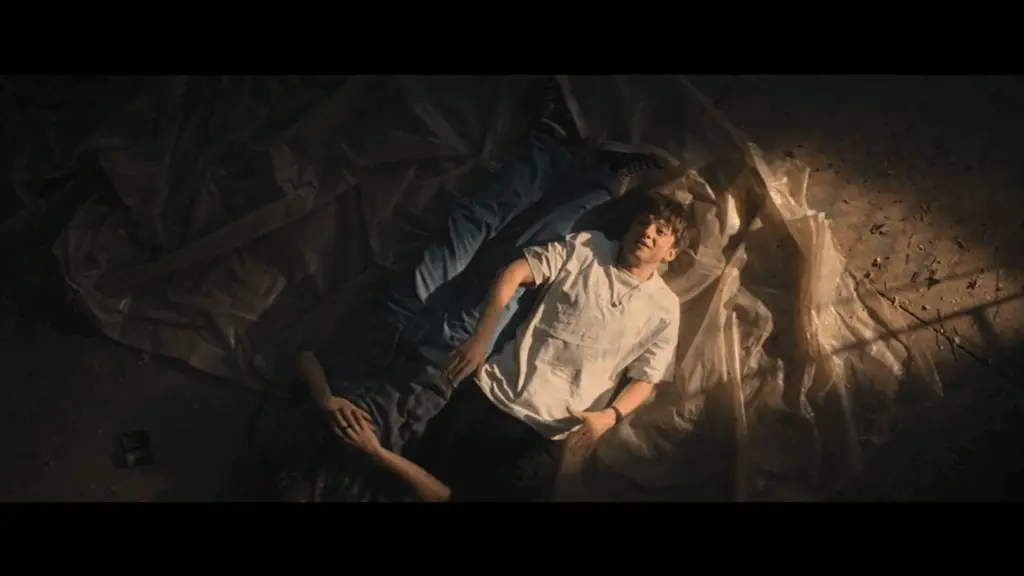
This is where Leviticus hits its apogee and begins spiraling downhill at the same time. The scene — which results in our protagonists puking all over the carpet and shaking violently — is beautifully filmed and has a LOT of symbolic power. The problem is that the film immediately shifts into an obtuse supernatural subplot immediately afterwards. The aforementioned love triangle is quickly severed — in more ways than one, no spoilers from me — and the film morphs into a mild recalculation of the It Follows formula. There are doppelgängers a plenty, but you’re never sure if the doppelgängers are flesh and blood and thus capable of harming our main characters are some sort of mental apparition. I can see why the filmmakers never make it 100 percent clear, but at the same time you have to give audiences some sort of rule book to follow. I guess the intent was to make you suspicious anytime certain characters are onscreen — what, with people not being who they say they are and all — but it’s a broken gimmick that slows the action down considerably. It actually ends up sapping away a lot of the intrinsic drama and suspense, and that’s one of the few unforgivable sins of any horror or horror-adjacent movie.
The two leads turn in strong performances and the ensemble cast is pretty good. The cinematography from Tyson Perkins is probably the best overall aspect of the entire film — the way he captures the industrial nothingness of rural Victoria is just fantastic, making what would seemingly feel like an alien world become hauntingly familiar to anyone living in middle America at the moment. It’s not a terribly effects heavy film, but the few moments of gore and ick are pretty well done, too. Alas, the score by Jed Kurzel is a tad underwhelming; when it should sting it swells and when it should go downbeat, it pops a little too hard. It’s not a terrible soundtrack, but it doesn’t necessarily gel with the rest of the movie, either.
It’s hard to dig too deep into the meat of Leviticus because it’s a film that ONLY makes sense once you’re aware of the spoilers — which aren’t divulged until very close to the film’s end. It ultimately becomes a surprisingly uplifting movie about not letting the prejudices of the unlearned dictate your life, but to get there we have to slog through a LOT of red herrings that, at the end of the day, feel pretty inconsequential considering the movie’s conclusion.

I think the metaphorical value of the film is going to be lost on American audiences, primarily because life for LGBT people in the U.S. is a nightmare that makes Leviticus look like a fair tradeoff in comparison. Shapeshifting ghosts aren’t all that terrifying in a place where the federal government defunds suicide prevention hotlines for queer youth on purpose. If anything, the parallels presented by Leviticus aren’t blunt ENOUGH to catch up with the horrors of our modern reality.
Some people will really enjoy Leviticus, others will not. It’s not exactly a polarizing movie in terms of identity politics, more a film that feels very familiar coming off recent genre offerings like Whistle and Smile. It’s a movie about inescapable doom, but in a society where the inescapable doom is already here it lands a little soft. You just wish Leviticus had more bite and a harder swing — and drew some more inspiration from the real life horrors on the other side of the Pacific Ocean.
Director: Adrian Chiarella
Writer: Adrian Chiarella
Starring: Joe Bird, Stacy Clausen, Mia Wasikowska, Jeremy Blewitt
Studio: Causeway Films
Distributor: Maslow Entertainment
Language: English
Runtime: 88 minutes
Release Date: June 18, 2026 (VOD)