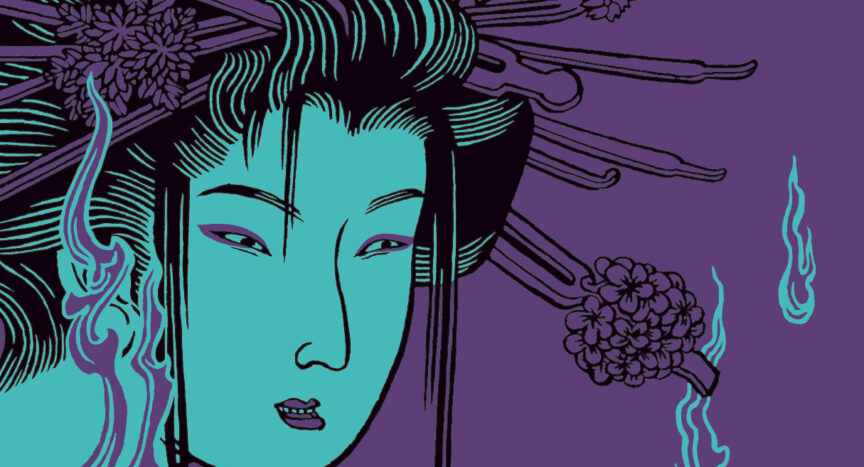
Wicked Horror interviews Yuko Shimizu, the award-winning artist behind the new release Japanese Ghost Stories!
Japanese Ghost Stories, just released by the Folio Society in time for spooky season, offers a collectible edition of twenty spine-tingling tales illustrated by artist Yuko Shimizu, a multi-award-winning Japanese illustrator based in New York City.
Set in the haunted world of Ancient Japan, the classic tales were collected and translated by Lafcadio Hearn, a 19th-century traveller and resident of Japan whose collections of supernatural stories drawn from folklore are wildly popular in Japan.
Shimizu, who contributed numerous illustrations to the work, is also an instructor at The School of Visual Arts and has more than twenty years of experience illustrating. Her work includes multiple disciplines; from pages of The New York Times, TIME, Newsweek, and The New Yorker to WIRED, covers for DC Comic, Penguin Random House, and Scholastic, and advertising for BBC, Apple, Google, Microsoft, Intel, Universal Pictures, SONY, Paramount, MTV, Nike, Hasbro, and Target, to name a few.
Additionally, she has collaborated with the United Nations, Smithsonian Museum, Philadelphia Museum of Art, and Library of Congress.
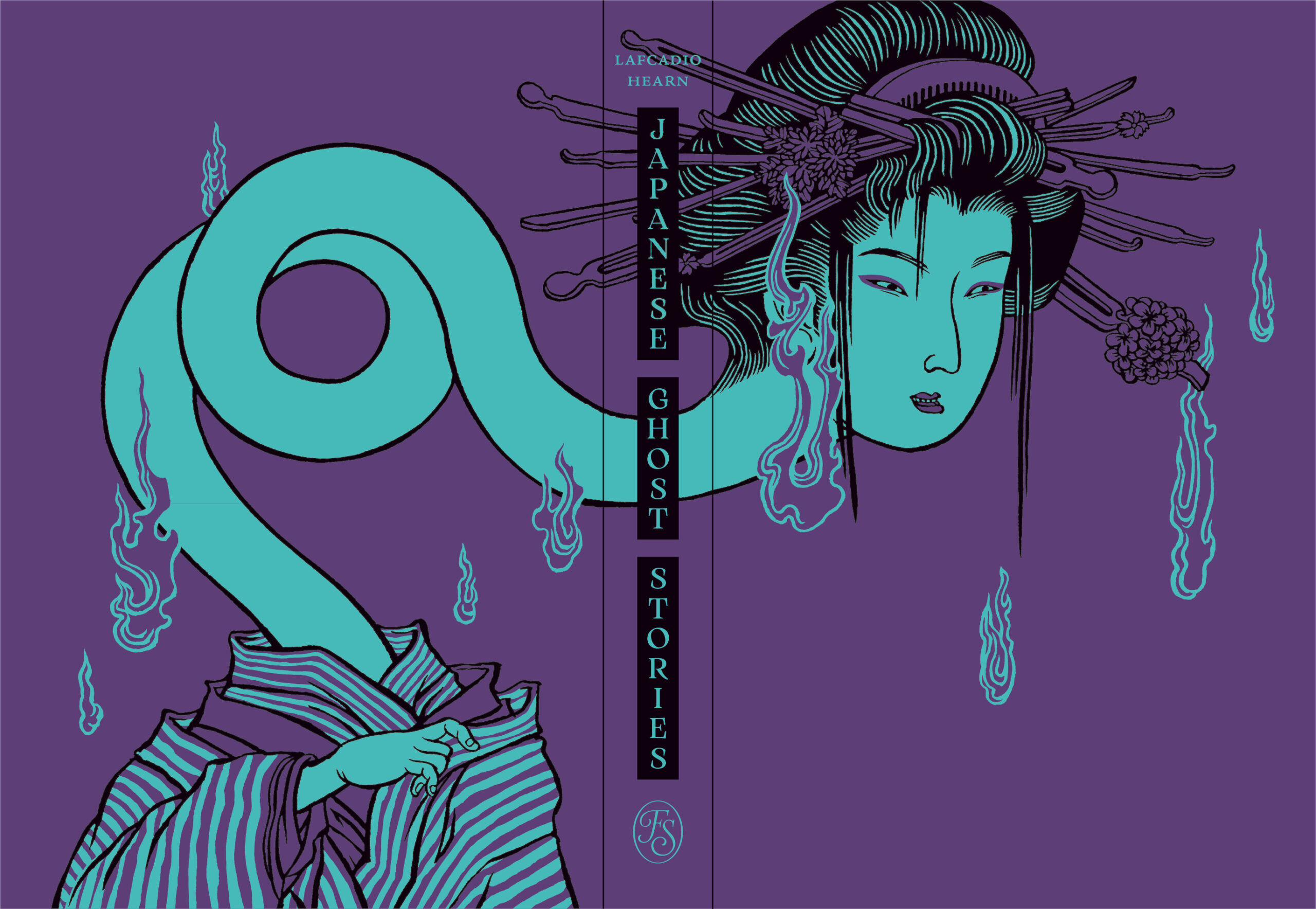

The book features twenty tales, including “The Story of Aoyagi,” in which a young samurai falls in love with a mysterious woman only to discover she is not what she seems; “Oshidori,” the haunting tale in which a mandarin duck mourns the loss of her lover, who was shot and killed by a hunter’ “The Dream of Akinosuké,” in which a man becomes the king of an ant kingdom; and “Rokuro-Kubi,” an action packed story in which a monk battles five flying heads.
In Japanese Ghost Stories, according to an official Folio synopsis, the dead wreak revenge on the living, paintings come alive, spectral brides possess mortal men and a priest devours human flesh. “These tales draw on the phantoms and ghouls of traditional Japanese folklore—including the headless ‘rokuro-kubi’, the monstrous goblins ‘jikininki’ and the faceless ‘mujina’ who stalk lonely neighborhoods. The stories are massively popular in Japan and highly regarded by folklore aficionados and horror enthusiasts alike.”
The volume is accompanied by five haunting double-page illustrations—as well as a frontis, cover, slipcase and endpaper art—by Shimizu, who has received multiple Gold and Silver Medals from the Society of Illustrators. This marks Shimizu’s third collaboration with The Folio Society, following Japanese Tales (2018) and The Great Gatsby (2025).
Wicked Horror posed a few questions for Yuko Shimizu about her art and inspiration in working on the volume.
WH: You’ve mentioned that research for Japanese Ghost Stories took you to the ancestors of manga. What did you explore in preparation for work on Ghost Stories illustrations?
Yuko Shimizu: The term “manga” has two different definitions. One is the Japanese comics, as you and your audience know. Another is that it was a term used by Katsushika Hokusai, one of the legends of Ukiyo-e woodblock print art of the Edo Period in the 19th Century. Both of them are my early influences.
For this specific project, I looked at a lot of illustrated books from the same period, including those of Hokusai’s. I wanted to make the book illustrations to have the mood, tone and feel of as if it was published as an illustrated book in Edo. (In reality Ghost Stories were published in the early 20th century, after the Edo period book trend was over).
WH: Were there artists from those realms who were particularly impactful as you researched?
Yuko Shimizu: Of course, Hokusai made some incredible book illustrations, and I found many I have never seen in the past. Which was so incredible, thanks to the widespreading of Japanese online antique book marketplaces.
But more interesting than the master Hokusai was that I found many more incredible book illustrations by artists I have no idea who they were. And I even found some ghost and yokai stories, which were very helpful.
I love researching for a new project in general, and this was a lot of fun.
WH: In one interview you mentioned you grew up surrounded by manga, was it meaningful to delve into those seminal forms?
Yuko Shimizu: My earliest art influences are manga, though probably the last one I seriously read was when Akira came out, so… 1980s? I learned how to draw by copying panels from my favorite manga growing up. Though it is not a part of my interest anymore, I still see heavy influences in my work that never go away. Influences are fascinating.
WH: How did you go about exploring the stories in Japanese Ghost Stories to find the visuals you wanted to develop?
Yuko Shimizu: I would probably have made a completely different set of images if the book was published in Japan. Initially, I was thinking of doing something very modern, because it is a book that’s been illustrated so much and my job as an artist is to make something new and fresh.
Then I ended up changing the direction to making something traditional with a modern edge. I realized I should make a completely different set of art for the western audience. I need to make images that really take the readers to the world they don’t know much about. One of the reasons why all the images are zoomed out and capture a large portion of the scenes in each environment.
WH: Was there a lot of freedom in creating the images and were the two-page spreads interesting opportunities for composition and scope?
Yuko Shimizu: Yes, Folio Society is really good at carefully choosing who is the best match for each project. Illustrators, not just myself, tend to do our best work when the clients believe the most important job they do is to match the artist with the project.
I had a lot of freedom. It also helped that there is no author or estate to get approval from. I suggested all the illustrations should be double page spreads to mimic the Edo illustrated books which were also mostly double pages. I added frames around each page, and also asked my friend and illustrator Ai Tatebayashi, who also has some calligraphy training, to write the titles on the edges to complete the look.
WH: Was there a favorite story in the mix?
Yuko Shimizu: I probably like the story of Hoichi the best because it is one of the most famous ghost stories of all time in Japan, but many of us had probably never actually read it. It is also very visual. Young blind storyteller performing to the ghost of dead soldiers. And the sitra written all over his body… It was also the illustrations in this book I enjoyed making the most.
WH: You’ve worked in many realms including comics, and you’ve done artistic renderings of science fiction scenes and icons like Godzilla. Was the creation of images for this volume a different experience in crafting fantastic images, bringing to life visions of folklore and the past?
Yuko Shimizu: There are many projects I have enjoyed over the last 20+ years illustrating, but I always feel that books are very special, I get to create the whole package, from cover to cover (even to the slipcase in this project). Magazines are cool, comic book covers are fun, and advertising can be exciting, but there is something very special about doing thorough research, making a decision on a direction of the book project, and spending a substantial amount of time creating one thing, one whole package of a thing.
WH: Where can readers go to learn more about you and your work?
Yuko Shimizu: My website is long overdue for an overhaul, but it is so extensive it is A BIG project, so I am putting it off a bit. But also, all my favorite works from the early days are there, at yukoart.com.While I may not be updating my website as often as I should, you can see some of my newer works on my Instagram @yukoart
Japanese Ghost Stories is now on sale exclusively from https://www.foliosociety.com/.