
The Zombie Movie That Forgot To Be A Zombie Movie
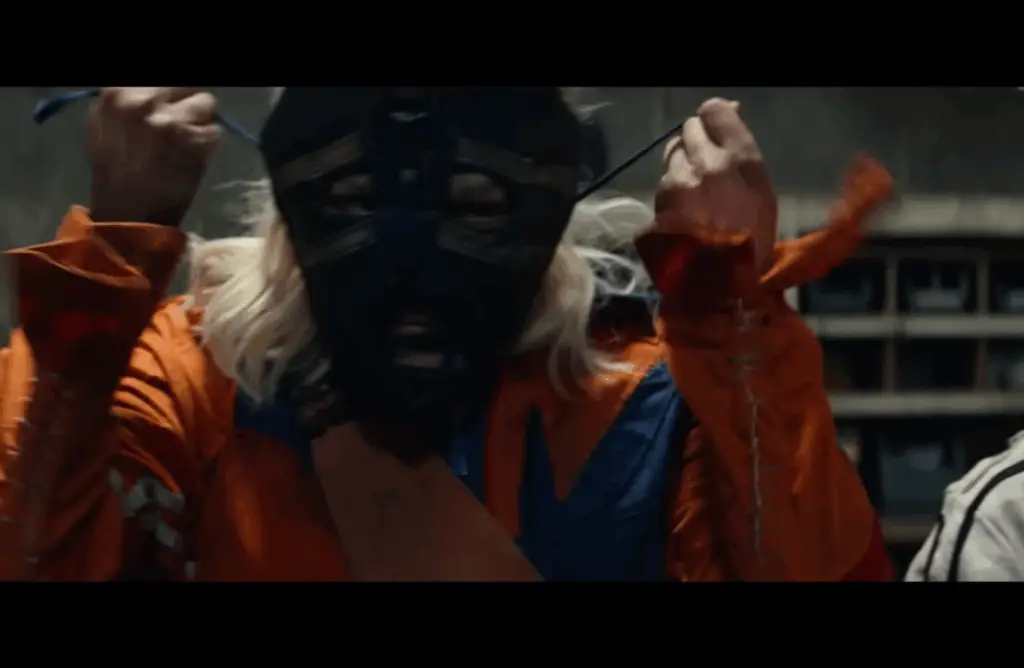
I‘m not sure how many different ways I can say “I’m totally lost” while I was watching 28 Years Later: The Bone Temple. The movie begins with a bunch of kids wearing Jimmy Saville wigs stabbing each other in the thigh arteries in an empty swimming pool and I guess now’s a good time to tell you that I haven’t seen any of the 28 Days/Weeks/Years/Centuries/Eons Later movies, not even the first one. So I apologize if my knowledge of the franchise lore is lacking, to put it mildly. But I guess that does make me an unbiased reviewer unswayed by nostalgia — if anybody can give you a genuinely objective take on this film, it would be yours truly.
This is another one of those post-apocalyptic zombie movies where the zombies are almost an afterthought. I mean, by now, we’ve done pretty much everything you can do with the zombie formula, except a political satire where people argue whether or not the living dead should have the right to vote (and I can’t tell you how long I’ve been waiting for somebody to make that one.) Instead, we’ve got yet another rag tag group of survivors slumming it up in the decayed remnants of society, stopping every now and then to engage in tribal warfare and scrape the corpse brains off the upholstery. But the zombies ARE a little bit different from what we’re used to seeing in all of those George Romero movies. These zombies are BUFF and run around naked in the grasslands, so they’re like survivalist, nudist, Cross-fit cavemen zombies just trying to protein-maxx on human noggins.
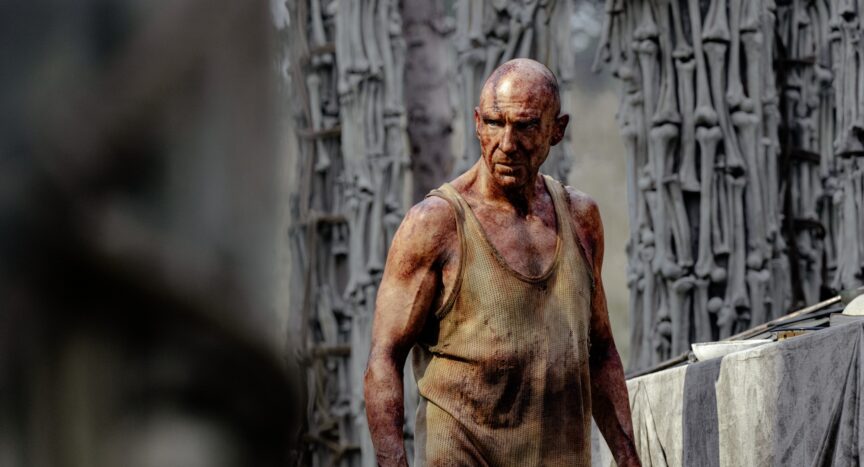
Of course, we’ve got a real thespian in Ralph Fiennes as the primary protagonist. When he’s not hanging out in the forest shooting blow darts at zombies he’s rocking out to old Duran Duran songs in his camper. He’s one of those actors who just feels too good to be doing a zombie rampage movie, but I guess he had a fun time playing a soft spoken zombie physical therapist who actually tries to REFORM the zombies by drugging them up and giving them pep talks on humanism. At times it almost borders on unintentional comedy; sorry, but it’s hard to make audiences take a film seriously when it has THIS much full frontal zombie nudity in it.
The rest of the non-zombie characters in the film are pretty generic. And since it’s an all U.K. cast, of course they have to get into all sorts of conversations about “Teletubbies.” I didn’t take me long to figure out that Jack O’Connell’s track-suit cult leader character was the REAL villain of the movie, and he’s clearly having a blast strutting around the place giving nonsensical lectures to his followers. Too bad he doesn’t have an American accent — with his shtick, I’d say there’s at least a 50/50 chance he would’ve gotten voted into Congress.
Amazingly the bulk of the film revolves around a bromance between Fiennes and Samson (played by Chi Lewis-Parry, rocking one of the most hilarious down-stairs prosthetics in cinema history, by the way.) I guess these scenes are supposed to be touching, but I literally LOL’ed when Fiennes considered injecting his towering, beefy zombie buddy with a (presumably lethal) dose of opioids and said something along the lines of “oh, if only I could get your consent.” Geez, talk about a morsel of dialogue you’d NEVER hear in a Lucio Fulci movie!

Look, just because it’s a zombie apocalypse doesn’t mean it’s the end of the world or anything …
As a wise man (probably) said ages ago, though, man cannot live off knife fights and long scenes of people vomiting in abandoned fields alone. There’s this persistent silliness to the whole affair, and every time it tries to make its tone graver and more somber it just makes the entire charade that much goofier. It’s been a long time since I’ve seen a wide-release, mainstream horror film that was so hard to interpret: I sincerely couldn’t tell if most of the movie was MEANT to be serious or tongue-in-cheek dark comedy.
I’m sure there’s supposed to be some kind of sociopolitical message in there somewhere. I mean, when a focal point of a film is a sanctuary literally made out of human skulls, there’s not much of a point in trying to be subtle. But I guess we’ll be watching movies furtively about the war between religion and science for as long as human beings are still able to hold up cameras.
And that’s the great weak point of Bone Temple as a whole. Existential dilemmas and faith crises might make for a good Ingmar Bergman movie, but it’s not really the best undercurrent for a friggin’ zombie apocalypse picture. Considering how few zombies actually show up in this movie, though, this might be the first POST-post-apocalyptic zombie film ever made. If you only catch bits and pieces of the film, you might think it’s just about a bunch of British people camping or something. Strictly as a living dead Armageddon film, this movie leaves quite a bit to be desired.
I can kinda-sorta see what director Nia DaCosta was going for here, but it never really comes together in a satisfying, cohesive package. I’ve seen some other horror-centric websites give this movie rave reviews and chalking it up as an all-time classic contender, but frankly, I’m just not seeing what all the hubbub is about.
That said, I will NEVER disparage any movie that ends with Ralph freaking Fiennes singing along to Iron Maiden while dressed as Pinhead from “Hellraiser.” Not only is it the best thing about the film, as far as I’m concerned it should’ve been the WHOLE movie.
WICKED RATING: 6/10