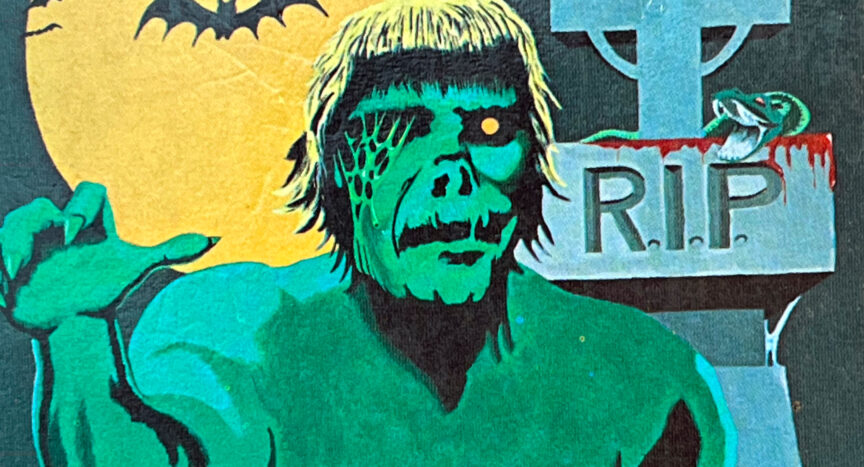
Before Goosebumps, there was Gooseflesh! Wicked Horror waxes nostalgic on the 1970s’ Scholastic horror anthology!
The “Spooky Season” label didn’t exist quite as we know it today when I was a teen. We just knew Halloween was coming. I sort of discovered the feel of the “October Country” and scary reads in junior high via the influence of Scholastic offerings, as many kids did. Specifically it was T.A.B., Scholastic’s Teen Age Book Club. It’s mission, according to the Scholastic website, was to offer affordable books to kids 13-18. I was probably at the lower end of that range, when I found Gooseflesh! (Berkley Medallion, December 1974) in the newsprint “magazine” offered to us at school. I probably paid a few pennies less that its 75 cent cover price via their order form.
I’m sure it was strategically placed in their offerings so that it would arrive in Halloween season. And it had a fabulous cover with a ghoul fresh from a grave with an ornate, serpent-draped marker.
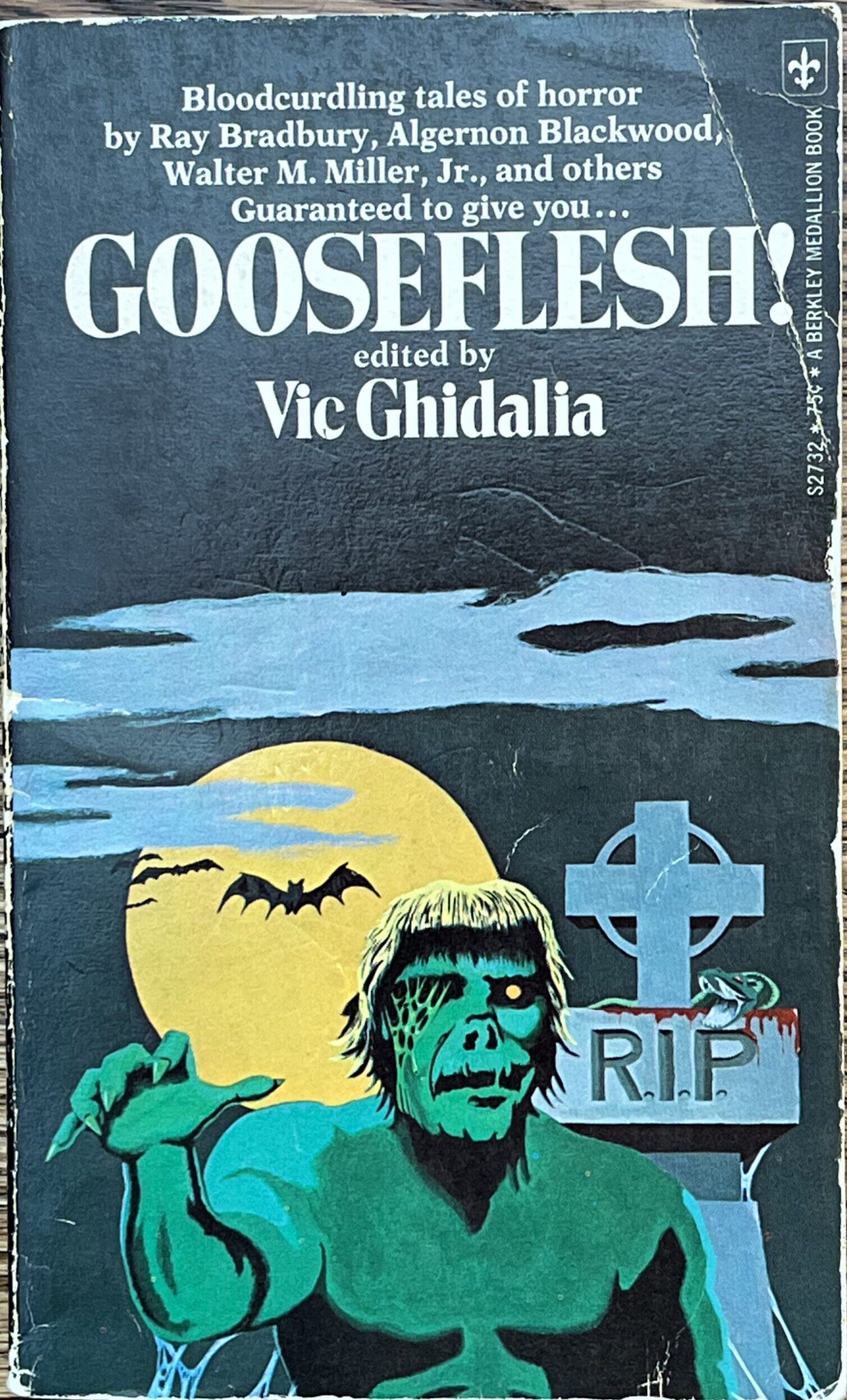

The Berkley Medallion paperback edition of Gooseflesh!
I didn’t really think about canny marketing. It just looked scary, and I’d already discovered Famous Monsters of Film Land and scary movies on TV and even the Aurora Monster Models. The phenomenon that began with Universal horror movies on TV in the sixties persisted into the seventies. The late David Skal’s The Monster Show (Penguin, 1993) discussed that cultural wave, and I went: “Hey, that was me!”
Gooseflesh! was edited by essayist and anthologist Vic Ghidalia (1926-2013), an ABC TV publicist and somewhat prolific editor in the seventies. It pulled together stories from Weird Tales, and as I read and the air cooled just a little with the recognizable fall you still experienced in Central Louisiana in those days, I instinctively came to understand the atmosphere and delight of spooky season.
The anthology kicked off not with a not-really-quiet horror by the man who really defined and set the tone for spooky season, Ray Bradbury. His The October Country may have offered quiet horror with masterful tales like “The Wind” or “The Scythe,” but “The October Game” in Gooseflesh suggested much more grisly terrors. (The story also appeared, probably appropriately, in the Alfred Hitchcock collection Stories They Wouldn’t Let Me Do on TV.)
It is a tale that calls for interpretation, though, so it set my young reading mind to work in gleaning the point as it unfolded a tale of a man who wants to hurt his wife, but not by killing her. That would be too quick and easy for her. He longs for a deep psychological torture in a marriage where things have not been right for a while, and his thoughts define October mood:
“By the sound of the children you knew the calendar day. By their screams you knew what evening it was. You knew it was very late in the year. October. The last day of October, with white bone masks and cut pumpkins and the smell of dropped candle fat … October didn’t help any.”
The date and his desire to bring hurt plays out in a game in the basement in the dark for his daughter and her friends as he begins a round “Feel the Witch’s Body Part’s.” Traditionally items like spaghetti are passed around as the witch’s innards. The man of the story has other plans, revealed spectacularly in the last line. Years later I’d discover the tale had been adapted for EC comics with a masterful final panel that delivered the chill without the typical EC sensationalism. (It’s collected in Home to Stay: The Complete Ray Bradbury EC Stories.)
A science fiction tale with some gory shocks followed “October Country.” “The Secret of Death Dome” by by Walter C. Miller Jr., author of A Canticle for Lebowitz. The story’s from Amazing Stories and focuses on Martians landing in the desert and establishing a domed residence. The military monitors it, and a soldier who gets too close suffers a hideous fate.
I was introduced to August Derleth in the collection as well with the tale “Three Gentlemen in Black.” The focal character’s killed an uncle and fled to England to wait for the sensation around the murder to die down, but the title figures show up to rattle his sense of distance and security.
And “Black Country,” which had just appeared for the first time in the fanzine Weirdbook, also introduced me to Robert E. Howard in the mix. The collection included a tale by Algernon Blackwood as well.
It was a really early introduction to some of the best names in weird fiction, though I wouldn’t fully understand just how great a mix of authors it offered until I learned more as my reading life progressed.
Most of all, it just provided me a delightfully-eerie early spooky season and paved the way for more horror and mystery reading as time moved on and more Octobers came my way.
Sadly it was many years later that I discovered Ghidalia’s Horror Hunters from 1971 in a used shop. If I’d found it sooner, I would have also been introduced to William Hope Hodgson, Fritz Leiber, Jr., Theodore Sturgeon and Robert Bloch sooner.
But Scholastic got me off to a good autumn start.