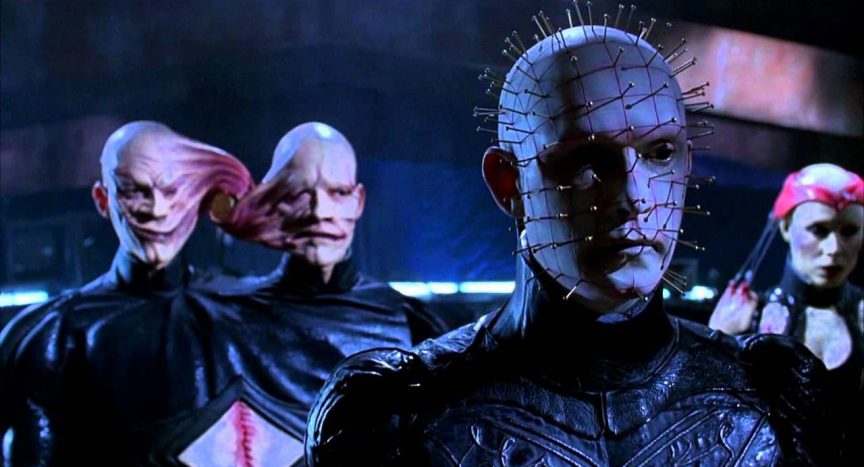
The Hellraiser franchise has always been rocky. The first two movies are absolutely spectacular. Hellraiser III is a bit underrated, but not without its problems by any stretch. And then you have Hellraiser: Bloodline which, for most people, is when the franchise really began to go downhill. It’s tough to argue considering that, even from a financial standpoint, Bloodline shows the most dramatic decline in profits of any horror franchise ever.
After this installment, the series would be sent straight-to-video, a well out of which it would never climb. Even the most lackluster Friday the 13th, Nightmare on Elm Street and Texas Chainsaw Massacre films didn’t result in those franchises suffering that fate (although it’s worth pointing out that Halloween would have suffered the same from Dimension, had it not been for a last-minute save by Jamie Lee Curtis).
But Hellraiser: Bloodline was not intended to be the movie that sealed the franchise’s straight-to-video fate. Rather, it was envisioned as the most ambitious Hellraiser yet. It was going to be the film that saved the franchise and cemented it as a cornerstone of modern genre fare. In the eyes of most, it might not have turned out that way, but it was full of great ideas and was ruined—as many productions are—by total mishandling from the studio.
Also See: Essential Quarantine Reading: 10 Books for the Bored Horror Fan


With this unique structure, the fillmmakers allowed themselves to make a sequel that picked up from the end of Hellraiser III while simultaneously giving us the beginning and end of the franchise at the same time. This was an amazing idea and it could have worked. The problem was that a big idea like this demanded a big movie, and that’s sadly not what Bloodline became.
Everyone went into this one with good intentions. Writer Peter Atkins, director Kevin Yagher—the amazing FX man behind Freddy, Chucky and the Crypt Keeper—and even Clive Barker himself believed they could make this the best Hellraiser yet. Atkins wrote a terrific story; like Hellbound, it was singular but not afraid to branch off into weird territory and do something different.
 Given that it was telling three stories at once, the script for Bloodline was the longest for any Hellraiser movie yet. And even though cuts were made, the movie resulted in a pretty long original cut. But even as they were shooting, things were being tossed out left and right and totally rearranged until they no longer made any sense.
Dimension was worried about the movie from the moment they started shooting, and had arguably never really understood the franchise from the moment they picked it up. They didn’t like to use the term ‘Cenobite’ in their films because they didn’t know what it meant and wouldn’t let Barker explain it to them. Even though he offered up several ideas and tried to pitch designs for new Cenobites, Dimension would not take his input and generally didn’t want him involved in any kind of hands-on capacity.
One of Barker’s biggest suggestions was that they should lessen Pinhead’s screen time, as he felt that was what had made the Hell Priest so impactful in the first two features. According to Barker, “My argument about Pinhead has always been that less is more. But the American audiences just go crazy when this guy comes on screen, so the studio said, ‘No. More is more.’”
See Also: It’s Just a Game: The Meta Weirdness of Hellraiser Hellworld
 According to director Kevin Yagher, Dimension was not happy with the initial cut, which was very rough and delivered when there was still shooting to be done. They didn’t like that Pinhead didn’t make an appearance until forty minutes in and they didn’t like that there was relatively little gore compared to the other movies.The studio considered the film complete with three whole weeks of filming left.
Joe Chappelle was then brought in for extensive reshoots—the same director who re-shot his own Halloween: The Curse of Michael Myers into a completely different movie. When all was said and done, Bloodline was the shortest Hellraiser until the no-budget Revelations came along in 2011. It failed critically, but not as much as it bombed at the box office. Yagher even had his name removed from the final product.
Bloodline is not the movie it should have been. But the great film that it was meant to be is clear while watching it. It’s sad that it wasn’t allowed to reach its full potential, but the finished product is not without merit. Even Barker, after everything, has some positive things to say about it: “I think there are some fine things in Hellraiser IV actually,” he told SFX. “There are some things that return almost to the tone of the first one. It’s uneven, no question, but overall I prefer it to number three.”
As uneven as it obviously is, Bloodline gave us a great extended prologue centering on Lemarchand and the creation of the box. It gave us a great new villainess in the form of Angelique–a big deal as the franchise had been founded on female villains with Julia Cotton in the first two pictures. It gave us Doug Bradley in one of his finest performances as his most iconic character. There are moments in the movie that work. Even still, it’s tough to watch and not think of what could have been. Ultimately, it had such sights to show us, and it showed us only one or two.