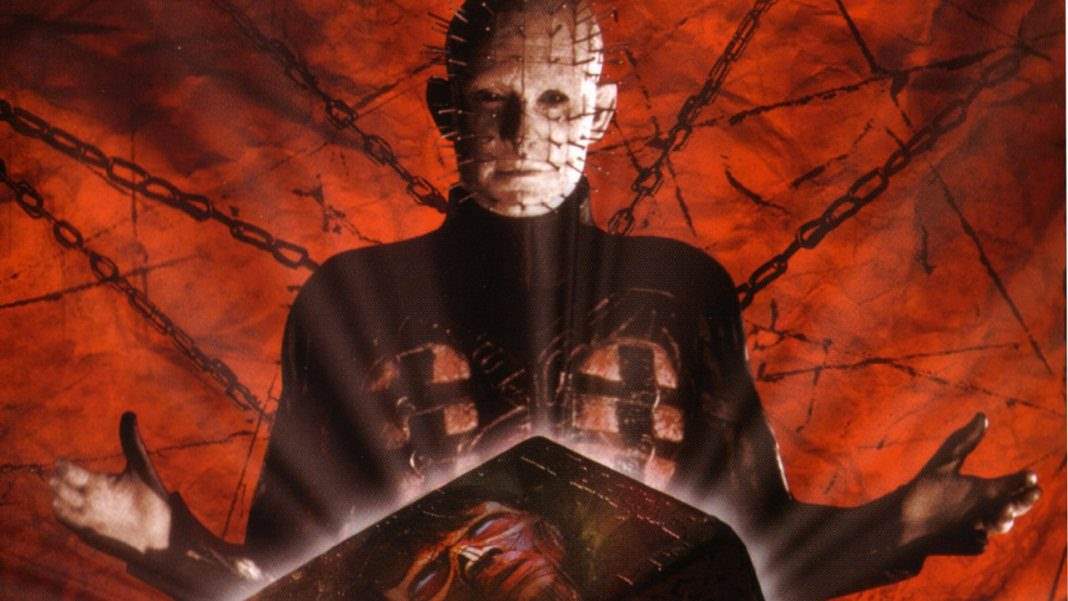
There was a time when Hellraiser was on the fast track to be the biggest, most imaginative, most sophisticated franchise of all time. The first two films are a one-two punch of not only great storytelling, but also demonstrated a variety of ideas that audiences had never seen before—a rarity for horror even in the late eighties. While the third entry still boasted a great script, the bigger budget saw it sacrifice some of the earlier artistry for action and spectacle. The fourth was a creative, incredibly imaginative entry that was, unfortunately, almost doomed from the start.
After the box office failure of the fourth film, the Hellraiser franchise took a radical change in direction. First and foremost, it was the first horror series to have four theatrical entries before going straight-to-video—where it has remained ever since. After Bloodline, the Hellraiser sequels kind of became anthologies. There was no interconnectivity between sequels anymore. They just told their own story. The problem with them, other than the budgetary and structural issues, is that they all basically told the same story with the exception of Hellworld.
The fifth, sixth and seventh entries, when broken down to their basic story structure, are essentially the same movie. Inferno is the worst of the three because you’re forced to follow one of the least likable protagonists you’ve ever seen through an investigation that leads to a twist that everyone could see coming. The sixth is a little bit better for making the protagonist a bit more likable at first and for bringing back Kirsty—although her presence in the film is completely wasted.


The first smart thing Deader does is set the action in Romania. It’s a simple move, but virtually every straight-to-video horror flick was shooting there at the time and trying to pass it off as something else. Taking the action to that part of the world allowed for a movie that felt bigger than it actually was—plus, it’s a location that invokes a kind of supernatural, otherworldy allure.
The plot centers on a self-destructive reporter named Amy Klein who is called into her editor’s office after he receives a tape. The footage appears to be of some kind of cult, of someone dying on camera and then coming back to life. She’s sent to Romania to determine its authenticity. Pinhead and the Cenobites come into play in a very interesting way. They want this stopped just as much as Amy does because whatever’s happening here is upsetting the natural order of things. Souls being wasted, essentially trapped on earth with Hell having no claim to them.
 Honestly, even though we’re meant to keep wondering what’s real and what’s not real as Amy has hallucinations throughout the film, the story is still refreshingly straightforward compared to the previous two Hellraiser entries. Where it ultimately shines over those two, though, is in the strength of its lead character. In many ways, Amy is the perfect combination of the determined, strong Kirsty Cotton of Hellraiser I & II and the ambitious reporter Joey Summerskill of Hellraiser III.
Of the many, many horror features Kari Wuher has starred in, this is her best performance. She creates a character that we want to follow on a descent into Hell and that’s what so many of the later Hellraiser entries were ultimately lacking.
Of course, like the two sequels preceding it, Deader was not originally written as a Hellraiser picture. But whereas you can see with other entries that they were rewritten and shoe-horned into Clive Barker’s mythology, it’s much less obvious in this one. Deader takes care with carefully crafted references and with weaving the Cenobites into the story in a way that makes sense. The next sequel, Hellworld, filmed at the same time, would take things too far in the other direction by essentially being stacked upon reference after reference without a ton of substance to it.
 Deader is primarily a story of accepting mortality. That’s what the Deaders themselves are trying to avoid. It’s not just crucial to their story, but Amy’s as well. She’s a reporter who is after a taste of death from the very beginning, but she doesn’t understand it or overly accept it at the start of the film. Her journey is about accepting her own mortality—it’s something that Deader has in common with Inferno and Hellseeker, but it accomplishes this in a much more satisfying way.
Yes, this is still the straight-to-video seventh entry in a long-running horror series, but as such I cannot believe how good it is. If you abandoned the franchise after its downward turn with Inferno, I would definitely consider going back and checking this one out. Had the series decided to end here, it would have been as fine a note as any to go out on. This movie isn’t near the quality of the first two, even three, features in the franchise. But there’s an earnest attempt made to go back to exploring what made those first couple great to begin with, and that’s something I truly appreciate.