Horror is evolving as a genre. Although your local multiplex is still peppered with the usual contenders, look a bit closer at the schedule and you’ll find the latest drama, thriller, or crime offering is closer to horror than you might expect. In this bi-weekly series, Joey Keogh presents a film not generally classified as horror and argues why it exhibits the qualities of a great flight flick, and therefore deserves the attention of fans as an example of Not Quite Horror. In this installment, we dissect the gruesomely realistic, Belfast-set thriller ’71.
The so-called Troubles in Belfast is arguably the darkest era in Irish history. If the repercussions weren’t still being felt today, one could feasibly imagine it being the perfect backdrop for a horror movie. In ‘71, novice director Yann Demange’s stark, shocking and, dare I say, quite troubling account of one fateful night during the Troubles, we get pretty damn close. A young, British soldier (played by rising star Jack O’Connell) finds himself in a living nightmare while stranded on the unfriendly, republican streets, where he’s hunted like a dog by hate-filled, bloodthirsty locals.
Up until last year, O’Connell was most well-known as the dude who yelled “I’m Coooooooook!” at the end of Skins, a moment that confused even die-hard fans of the show, but a trio of terrific performances–in Angelina Jolie’s uneven Unbroken, not-quite-horror prison drama Starred Up and finally ’71–launched him spectacularly into the stratosphere. The jack-the-lad Brit may have been playing most against type in Unbroken, but it’s in ’71 where he comes into his own as an actor, taking centre-stage, in a challenging role, with aplomb.
DeMange keeps the camera tight on O’Connell for much of the film’s 99-minute run-time, catching his confusion, his cockiness and, in one desperately sad sequence, his abject terror. O’Connell’s Hook is established from the outset as a bit of a tearaway, having graduated from the same orphanage in which his younger brother is now situated, to join the ranks of the British army. We know that Hook is a fighter, because we see him tough it out through training exercises, and we know he has something to fight for, because we’ve watched him interact with his sibling.
Hook’s relationship with his brother is key because, although ’71 is ostensibly about a violent, political conflict, at its core is a strong message about the effect these kinds of battles have on the children forced to live through them (Demange stated he specifically wanted “to talk about kids, who are barely 20 years old, being soldiers”). This is seen through the eyes of Hook’s brother, an upstart, wannabe republican freedom fighter and a tragically misguided, yet hilariously precocious, young fellow who assists the soldier in his time of need.
Although Demange presents both sides of the argument, suggesting that neither is in the right, his view of the conflict is resolutely bleak. Violence begets violence, adults who act like spoiled children, and encourage their progeny to follow their bad example will pay the price and so forth. As one of the only locals with a conscience, Irish actor David Wilmot is frustrated at every turn, and his fate is sealed with a chilling final line from Sean Harris’ terrifying British MRF officer.
Although the early sequences set Hook up as strong and determined, when he finds himself abandoned it’s not long before he crumbles. ’71 is essentially, then, a nail-biting cat and mouse chase through the Belfast streets, with Demange ensuring the locations are left as murkily unknown to Hook as they are to us. It’s never clear whether he’s in enemy territory, but a blanket of darkness hangs over everything. A final showdown in The Divis Flats (a republican stronghold that has since been demolished and is resurrected here in Sheffield’s Park Hill Flats) is particularly claustrophobic, as the soldier weaves his way in and out, dangerously in view of his hunters.
Shot with verve and edited sharply, there’s no messing around with ’71. Much like the fighters themselves, its purpose is immediately clear and there’s no respite once it gets going. A brutal, bleak watch, its honesty is impressive–there are no real heroes here. Although we are meant to be rooting for Hook, he’s not without fault. He, along with the rest of the British soldiers, totally underestimates what he’s getting himself into and pays the price as a result.
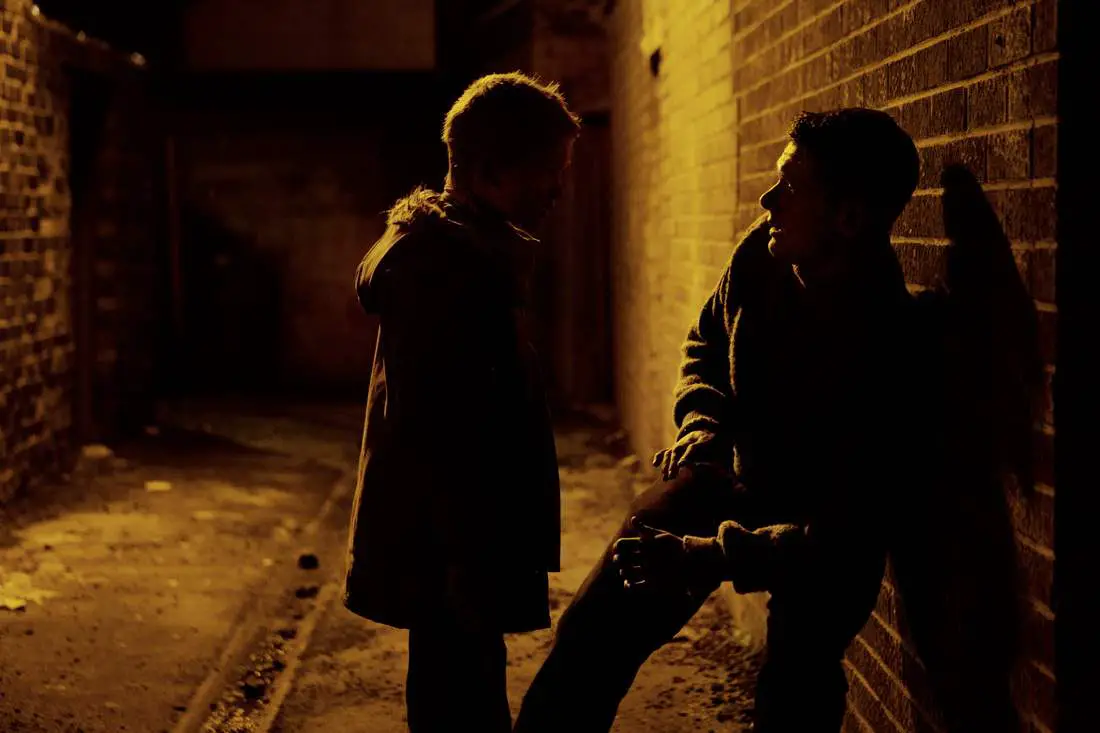

Demange utilises sections of effective shaky-cam during the riots or when, for example, Hook is legging it down various dark street corners. The adrenaline hits once he’s left behind and it doesn’t let up, even after the depressingly realistic denouement. Belfast composer David Holmes’s plaintive, evocative score, which is often little more than lightly-plucked guitar strings, is achingly perfect. While a cast of British and Irish character actors, including Harris, Wilmot and Killian Scott, alongside talented newcomers such as Barry Keoghan, provide local colour.
However, it is O’Connell’s astonishing, exceptional, career-making performance in the central role that elevates ’71 into soon-to-be-classic territory. It’s difficult to imagine anyone else playing the part and, although he is well on his way to achieving heartthrob status, it’s roles such as these that mark O’Connell out as one to watch in spite of his good looks. Considering the actor himself is a working class kid done good, he inhabits Hook to an almost heartbreaking degree.
’71 is a gritty, raw, unrelentingly realistic look at one of the bleakest and most frightening periods in Irish history. It’s not an easy watch, but it’s a necessary one, for those familiar with the conflict and otherwise.